
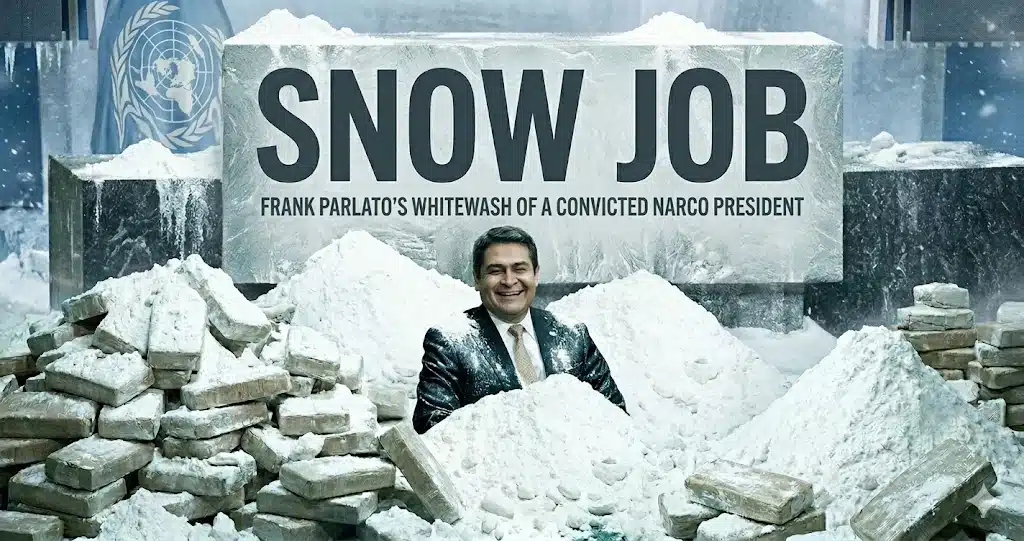
The prosecution of former Honduran President Juan Orlando Hernandez resulted from an investigation spanning multiple U.S. administrations, starting years before the Biden presidency. Evidence presented at trial detailed extensive drug trafficking and bribery, contradicting claims that the legal proceedings were a contemporary political operation or a partisan plot.
Factual errors regarding the timing of Honduras’s diplomatic shift toward China and the omission of trial testimony undermine arguments for a politically motivated frame-up. While the subsequent presidential pardon influenced regional politics, the underlying conviction rested on a legal foundation established by career prosecutors over several years.
Parlato’s first article in his JOH series was published on Artvoice and Frank Report on April 29, 2026
Overview
Parlato’s Part 1 functions as an extended framing device: establish Hernandez as a loyal U.S. ally, cast the prosecution as a Biden political operation, and present Trump’s pardon as strategic genius. The piece contains a mix of accurate facts, significant errors, and serious analytical omissions that collectively mislead readers about who prosecuted Hernandez, why, and on what evidence.
Claim-by-Claim Fact-Check
✅ ACCURATE: Basic facts about the conviction and pardon
Parlato correctly states that Hernandez was convicted in March 2024, sentenced to 45 years, held at FCI Hazelton (West Virginia), and pardoned by Trump on December 1, 2025. He correctly identifies the convicting court as the Southern District of New York, the charges as cocaine importation conspiracy plus two weapons offenses, and notes that Hernandez was 57 at the time of release. The 0.74% margin of Asfura’s victory, Castro’s inauguration date of January 27, 2022, and the 82-year duration of Honduras’s recognition of Taiwan are all accurate.
❌ MISLEADING: “Less than four years of a 45-year sentence”
This framing conflates two different timespans. Hernandez was extradited to the U.S. in April 2022 and spent time in pre-trial detention before trial and sentencing. He was not sentenced until June 26, 2024. He was released December 1, 2025, meaning he served approximately 19 months of his actual 45-year prison sentence. While he was in U.S. custody for roughly 3.5 years total, presenting this as time served against a 45-year sentence inflates the figure and obscures how little of the punishment he actually received.
❌ SIGNIFICANT ERROR: “Biden DOJ” as originator of the prosecution
This is the article’s most consequential misrepresentation, and it is foundational to the entire “framing” thesis.
The investigation into Juan Orlando Hernandez did not begin under Biden. According to reporting by the New York Times and court documents, the DEA began investigating Hernandez for drug trafficking and money laundering around 2013, during the Obama administration. His brother Tony Hernandez was arrested at Miami International Airport in November 2018, during the Trump administration, and was convicted in October 2019, also under Trump’s DOJ. During the Tony Hernandez trial, SDNY prosecutors publicly identified Juan Orlando as a co-conspirator in court filings.
The superseding indictment against JOH was returned January 27, 2022, technically Biden’s DOJ, but it was the culmination of an investigation spanning at least three administrations. The case had been built for years. Crucially, the same SDNY prosecution team that worked the Tony Hernandez case (including Emil Bove III) continued working the JOH case. Bove later resigned to defend Trump in the hush-money trial, and Trump subsequently appointed him to a seat on the 3rd U.S. Circuit Court of Appeals. If the JOH prosecution were a Democratic plot against a U.S. ally, one would have to explain why Trump rewarded one of its key prosecutors with a lifetime federal judgeship.
Parlato never mentions any of this. The “Biden DOJ” framing requires the reader to forget that the evidentiary foundation was constructed almost entirely during Trump’s first term.
❌ MISLEADING: The indictment as a “tip of the hat to Castro”
Parlato frames the January 27, 2022 indictment date, the same day as Castro’s inauguration, as suspicious and almost conspiratorial. But the explanation is far more mundane: Hernandez lost presidential immunity the moment he left office. The indictment was sealed and not made public until his extradition in April 2022. Prosecutors routinely file charges when they can legally do so. Hernandez had, in fact, tried to secure a seat in the Central American Parliament (PARLACEN) specifically to claim legislative immunity and avoid prosecution, a detail Parlato omits entirely. The timing of the indictment reflects the expiration of his immunity, not a political signal to Castro.
❌ FACTUAL ERROR: “Extradited the same year his successor pulled the country into Beijing’s sphere”
Parlato writes: “The Biden administration extradited Hernandez the same year his successor pulled the country into Beijing’s sphere.”
This is factually wrong. Hernandez was extradited in April 2022. Honduras switched diplomatic recognition from Taiwan to China in March 2023, more than eleven months later, in a different calendar year. Parlato has the years wrong, which undermines his central synchronicity argument. The two events were separated by nearly a year.
❌ OMISSION: The scale and nature of the evidence
The article presents the conviction entirely through the lens of political motivation while omitting the prosecution’s evidentiary record. The jury heard:
- Testimony that Hernandez received millions of dollars in bribes from drug trafficking organizations, including a $1 million bribe delivered personally by El Chapo, in exchange for state protection of cocaine shipments
- Evidence that over 400-500 tons of cocaine moved through Honduras to the United States under his protection, beginning in 2004, years before his presidency
- Testimony and documentary evidence that he used drug proceeds to finance his political campaigns and commit electoral fraud in both the 2013 and 2017 elections
- The conviction of his own brother, former Honduran Congressman Tony Hernandez, for the same conspiracy in 2019, during Trump’s presidency, under Trump’s DOJ, with Trump-appointed prosecutors
- Evidence that Hernandez had at one point stated he wanted to “stuff the drugs right up the noses of the gringos”
Hernandez’s sentencing judge, P. Kevin Castel, called him “one of the most culpable defendants ever prosecuted” in the SDNY and said the sentence should warn “well-educated, well-dressed” officials that status does not insulate them from justice. A jury, not a Biden appointee, rendered the guilty verdict after a three-week trial.
None of this appears in Parlato’s article.
⚠️ CONTESTED: “The first Latin American country in more than 30 years to begin moving away from Beijing”
Parlato claims Honduras is “the first Latin American country in more than 30 years to begin moving away from Beijing after recognizing it.” This is presented as fact but appears to be unverified or significantly overstated. Honduras has not formally restored recognition of Taiwan as of this writing. Asfura’s vice president discussed intentions to do so “slowly, as Chinese contracts can be unwound.” A stated intention to eventually move is not the same as a completed diplomatic reversal, and Parlato’s framing runs well ahead of the facts.
⚠️ INCOMPLETE: The election narrative and voting irregularities
Parlato’s account of the Asfura victory is broadly accurate but strips out crucial context. The final result, announced on Christmas Eve, nearly a month after the election, was disputed by both Nasralla’s Liberal Party and the ruling LIBRE party. The electoral count was halted multiple times due to technical failures. Roughly 15% of tally sheets required hand-counting. Multiple electoral council members dissented from the official result announcement. Parlato presents this as a clean win driven by Trump’s pardon; the reality was a chaotic, protracted count with active fraud allegations from multiple directions.
Trump’s Truth Social post warning that “there will be hell to pay” if Asfura lost, and his labeling of centrist Nasralla as a “borderline communist,” were examples of direct foreign interference in a sovereign election that Parlato frames as “strategic brilliance.” This is worth naming clearly: a sitting U.S. president threatening economic consequences against a sovereign nation to swing its election is not geopolitical sophistication. It is coercion, and it sets a precedent that other powers, including China, can point to for their own interventionism.
Core Analytical Problem: Post Hoc Reasoning
The article’s structure is: (1) Hernandez was a U.S. ally; (2) he was prosecuted after leaving office; (3) Honduras subsequently aligned with China; (4) therefore the prosecution was politically motivated. This is post hoc reasoning. The fact that a geopolitically inconvenient outcome followed Hernandez’s removal from power does not mean the prosecution caused it or was designed to produce it. The Honduras-China switch was driven by Castro’s longstanding ideological commitments and Beijing’s outreach, dynamics that predated the indictment and would have occurred regardless of whether Hernandez was prosecuted.
Similarly, the fact that pardoning Hernandez turned out to be useful to Asfura’s electoral prospects does not retroactively validate the claim that the prosecution was a “frame.” A pardon can be politically useful and the underlying conviction can still be legally sound.
What the Article Gets Right (and Why It Still Misleads)
Parlato correctly identifies a real tension: the U.S. prosecuted a former ally while his pro-China successor took power, and Trump’s pardon appears to have influenced a close election result in America’s favor. These are legitimate observations about the intersection of law and geopolitics, and there are legitimate questions about the reliability of cooperating witnesses in SDNY narco cases.
But acknowledging those tensions is not the same as proving a frame-up. Parlato conflates them throughout Part 1, presenting the geopolitical argument as if it constitutes exculpatory evidence, which it does not. A head of state can both cooperate with U.S. counternarcotics goals publicly and accept drug cartel bribes privately. The evidence presented at trial suggested that is precisely what Hernandez did.
Summary Scorecard
| Claim | Verdict |
|---|---|
| Pardon date, sentence, age, prison location | ✅ Accurate |
| 82-year Taiwan recognition | ✅ Accurate |
| 0.74% election margin | ✅ Accurate |
| “Less than four years” of sentence served | ❌ Misleading (19 months actual sentence) |
| “Biden DOJ” as prosecution originator | ❌ Significantly misleading |
| Indictment as political signal to Castro | ❌ Misleading (immunity-expiration timing) |
| Extradition “same year” as China switch | ❌ Factually wrong (different years) |
| Scale of evidence against Hernandez | ❌ Omitted entirely |
| “First Latin American country moving away from Beijing” | ⚠️ Unverified/overstated |
| Election as clean strategic win | ⚠️ Incomplete (disputed count, irregularities) |