
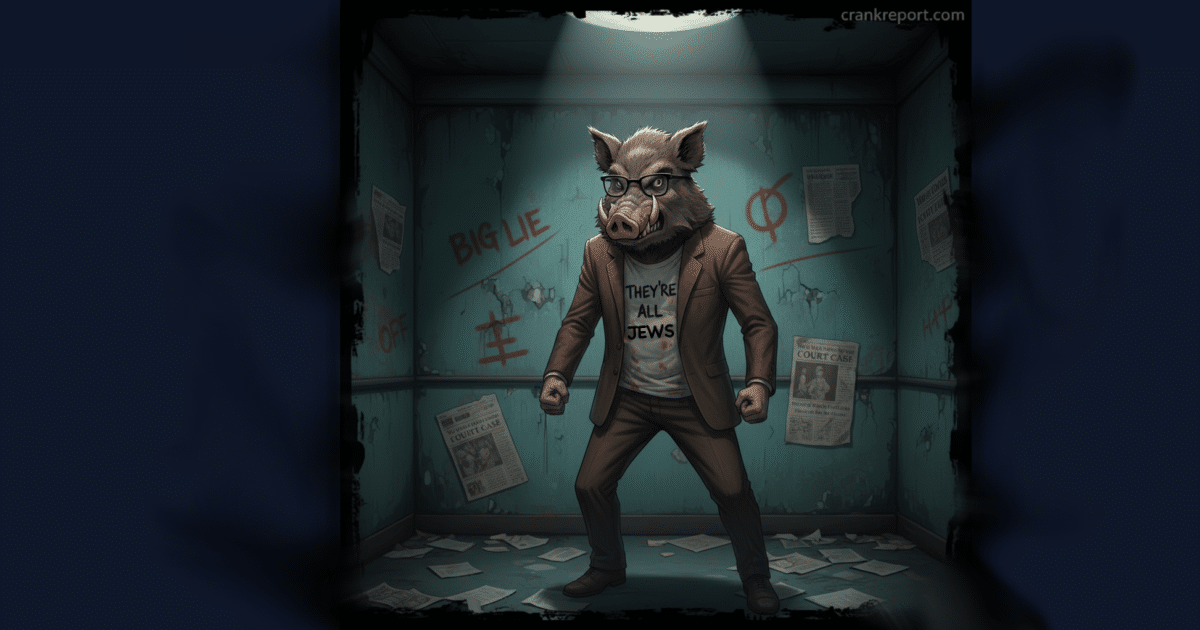
A high-stakes legal battle is currently unfolding in New Haven, Connecticut, as Paul Boyne, 62, faces 18 felony counts of stalking and electronic stalking. While the case is fundamentally about the limits of protected speech versus criminal threats, a parallel battle is being fought in the court of public opinion.
A recent article published by the Frank Report titled “Paul Boyne Spent 18 Months in Jail for Blog Posts” exemplifies a classic strategy in modern disinformation: the “whistleblower-in-peril” narrative. By framing a defendant charged with targeted, weapon-specific threats as a victim of a “corrupt judiciary,” such articles attempt to delegitimize the rule of law.
This report analyzes the specific claims made in the Frank Report and provides a factual rebuttal based on court records, law enforcement affidavits, and established legal precedents.
Fact-Check: Political Speech or Criminal Conduct?
The core of the Frank Report’s defense is that Boyne’s words, which included calling for a “.50 cal to the head” of specific judges, were merely “vile” political hyperbole. However, looking at the facts reveals a pattern that exceeds the boundaries of protected dissent.
1. Claim: Boyne is being prosecuted for “mean and vile” words.
The Reality: Boyne is charged with felony stalking, which requires the state to prove that his conduct would cause a reasonable person to fear for their safety. According to the arrest warrant and investigative records from the Connecticut State Police Computer Crimes Unit, Boyne did not just express anger; he published:
- Specific Home Addresses: High-resolution photos and addresses of judges’ private residences.
- Tactical Descriptions: Descriptions of the property layouts, including the “woods behind the house” from which a “sniper shot” could be taken.
- Weapon Specificity: Repeated references to high-powered ammunition (.50 caliber and .308) capable of piercing armor and glass.
The Frank Report omits that Judge Jane Grossman told investigators she viewed her security footage in terror after Boyne described the specific room in her home where she could be targeted. In the eyes of the law, the transition from criticizing a judge’s ruling to describing the line of sight for a sniper rifle at their residence is the transition from speech to stalking.
2. Claim: “No one was harmed,” therefore no crime occurred.
The Reality: Stalking and threatening laws are preventative by design. As noted in the 2023 Supreme Court ruling Counterman v. Colorado, the state is not required to wait for a physical assault to occur before intervening. The legal standard for a “true threat” involves the speaker’s awareness of the risk that their words will be perceived as a threat. By superimposing a judge’s face into rifle crosshairs—as Boyne did with Judge Thomas Moukawsher—the intent to intimidate is legally actionable, regardless of whether a trigger was pulled.
3. Claim: The prosecution is “retaliation” for Boyne’s grievances with the Family Court.
The Reality: The Frank Report attempts to paint Boyne as a “whistleblower” against a “racketeering” network. In reality, Boyne’s history with the court is one of personal litigation. According to court records, Boyne’s parental rights were terminated after years of volatile behavior, including a 2013 arrest for “swinging a leather satchel in a threatening way” at a lawyer. The investigation into his blog, TheFamilyCourtCircus.com, was not a response to “whistleblowing,” but a response to years of targeted harassment that included antisemitic and racist slurs, leading to the involvement of the State Police Hate Crimes Unit.
Rhetorical Analysis: The Anatomy of a Misinformation Campaign
The Frank Report article utilizes several hallmarks of coordinated crisis messaging intended to obscure criminal behavior:
- The False Equivalence: The article cites Watts v. United States (1969), comparing a general protest against the draft to Boyne’s specific, repeated targeting of individuals’ homes. Legal experts note that Watts protected “political hyperbole” directed at the President in a public square; it did not grant a license to dox judges and describe their assassination at their private residences.
- The “Corrupt System” Trope: By leaning heavily on the “corrupt judiciary” narrative (using terms like “JEWdiciary”), the campaign seeks to shift the focus from Boyne’s actions to the alleged “tyranny” of the state. This is a common tactic used to radicalize audiences and justify violent rhetoric as “self-defense.”
- Strategic Omission: The article portrays the state’s plea deal (time served) as a sign of a weak case. In reality, such deals are standard in high-profile First Amendment cases to avoid the cost of a trial. Boyne’s refusal of the deal is framed as “principled conviction,” while the state’s evidence—including recorded jail calls where Boyne reportedly discusses the blog’s impact—is downplayed.
Conclusion
The trial of Paul Boyne is indeed a test of the First Amendment, but not in the way the Frank Report suggests. It is a test of whether the law can protect public officials from targeted, weaponized intimidation intended to subvert the judicial process.
To frame the solicitation of a “.50 cal to the head” as “legitimate dissent” is not a defense of free speech—it is an assault on the safety and independence of the judiciary. As the trial proceeds, the public must distinguish between the right to criticize a system and the alleged criminal conduct of stalking those who serve within it.
Sources:
- State of Connecticut v. Paul Boyne, New Haven Superior Court Records (2023-2026).
- Boyne v. Guadarama, U.S. District Court for the District of Connecticut, 3:24-cv-00065.
- Connecticut Division of Criminal Justice, “Virginia Man Arraigned on Charges of Cyberstalking,” Oct 20, 2023.
- Counterman v. Colorado, 600 U.S. 66 (2023).