
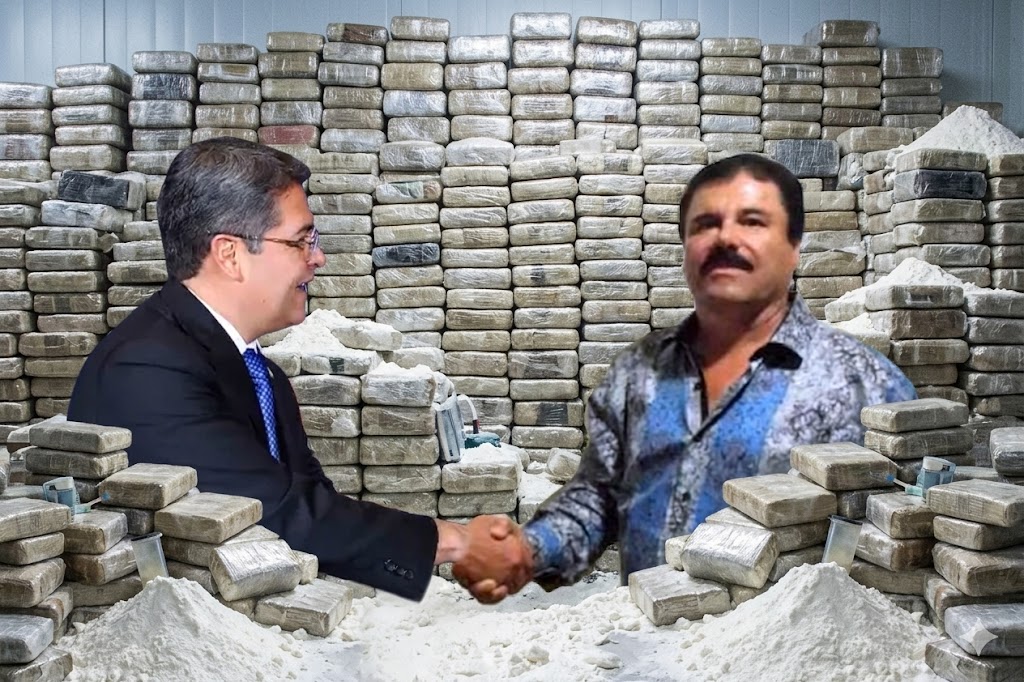
A factual analysis of the Juan Orlando Hernandez prosecution reveals significant inaccuracies and legal mischaracterizations in recent defense-oriented reporting. While the initial charges are described correctly, the report questions established jurisdictional laws regarding weapons and overstates the capability of historical electronic surveillance used to monitor cartel operations.
The analysis highlights significant omissions, such as the existence of drug ledgers and testimony from multiple cooperating witnesses. These arguments were addressed during the trial, where a jury found the evidence credible beyond a reasonable doubt. The resulting unanimous conviction on all counts reflects the established legal process.
Parlato’s second article in his JOH series was published on Artvoice and Frank Report on April 30, 2026
Overview
Part 2 shifts gears, which is worth acknowledging. Parlato opens by conceding that a pardon can serve American foreign policy interests and the pardoned man can still be guilty. That is an honest framing. But the article then spends its remaining length casting doubt on the prosecution’s case using a combination of legitimate observations, selective omissions, legal mischaracterizations, and at least one claim that relies entirely on the defendant’s wife as its source. The result reads like a well-dressed defense brief, not a fact-checked analysis.
Claim-by-Claim Fact-Check
✅ ACCURATE: The basic structure of the charges
Parlato correctly describes the three counts: cocaine importation conspiracy, and two weapons charges related to machine guns used in furtherance of the drug conspiracy. He is also correct that the weapons charges carried substantial mandatory minimums, that the cocaine conspiracy allegation spans 2004 to 2022, and that the alleged El Chapo bribe occurred in 2013 when Hernandez was a presidential candidate, not yet president. These are accurate descriptions of the publicly available court record.
❌ MISLEADING: The machine gun charges as a jurisdictional absurdity
Parlato argues that because the machine guns “were never used in the United States” and “were never in the United States,” the weapons charges are somehow improper or suspicious. This reflects either a misunderstanding of federal conspiracy law or a deliberate effort to mislead readers unfamiliar with it.
Under 18 U.S.C. Section 924(c), using or carrying a firearm in furtherance of a drug trafficking crime does not require the weapon to be physically present in the United States. The drug trafficking crime being furthered was a conspiracy to import cocaine into the United States. Weapons used anywhere in that supply chain, including in Honduras, fall within the jurisdictional reach of the charge. Federal courts have consistently upheld this theory. The charges were not novel or questionable on jurisdictional grounds. They were textbook 924(c) counts applied to an international drug conspiracy.
❌ MISLEADING: The El Chapo surveillance argument
This is the most rhetorically effective section of the article and also the least grounded in what is actually established. Parlato claims that because DEA agent Andrew Hogan had El Chapo under “continuous BlackBerry surveillance” in 2013, and the DEA “was reading his texts in real time,” agents “would have seen him cross two international borders with a million dollars in cash.”
There are several problems with this.
First, the source for the “continuous surveillance” claim in the Parlato series is a tweet posted by Hernandez’s own wife, Ana Garcia de Hernandez, citing Hogan’s book selectively. That is a defense advocate’s reading of a popular book, not an independent factual finding. Hogan’s surveillance operation, as described in his book and interviews, involved intercepting communications through specific devices associated with El Chapo’s inner circle. It was sophisticated and eventually successful, but El Chapo evaded the DEA for over a decade specifically because he was expert at counter-surveillance. He used multiple phones, changed devices regularly, and used couriers for sensitive communications. The DEA captured him in February 2014, not because they had tracked his every movement in real time for the preceding year, but because they painstakingly mapped his pattern of safe house usage.
Second, the claim that the DEA would necessarily have intercepted a physical cash delivery crossing two international borders through their BlackBerry monitoring is not supported by anything in Hogan’s book. Monitoring a device’s messages is not the same as tracking every physical movement of a person in real time. Cartel operations routinely separated electronic communication from physical cash movements precisely to avoid detection.
Third, and most importantly, this argument was made at trial. Hernandez’s defense team raised it. The jury, which heard it, still convicted.
❌ MISLEADING: “Hernandez’s name does not appear” in the El Chapo trial
Parlato presents the absence of Hernandez’s name from the El Chapo EDNY trial as a major red flag, almost as if it proves the prosecution’s later theory was invented. This is a significant misreading of how that trial worked.
The El Chapo prosecution was about Guzman’s cartel operations, his personal role in specific drug shipments, murders, and bribery of Mexican officials. The Hernandez bribe was alleged to have been delivered through Tony Hernandez to a Honduran political figure. It was a side transaction, not among the core counts Guzman faced. Prosecutors have no obligation to include every bribe a defendant ever paid in a single charging document. The absence of Hernandez’s name from the El Chapo trial no more disproves the bribe than the absence of a particular Mexican governor’s name would disprove bribes paid to other governors who were later prosecuted separately.
Furthermore, the El Chapo trial did feature testimony from cooperators, including cartel members and associates, who described a vast bribery network. The absence of one specific name from one specific trial is not exculpatory evidence for a separately tried defendant.
⚠️ PARTIALLY LEGITIMATE: Ardon’s changed location testimony
Parlato’s claim that Alexander Ardon changed the location of the alleged El Chapo meeting between the 2019 Tony Hernandez trial and the 2024 JOH trial is the strongest specific point in the article. If accurate as described, a location change in sworn testimony from one Manhattan jury to another is a genuine inconsistency that any competent defense attorney would exploit and that any juror would be right to scrutinize.
However, several things need to be said about it.
The jury heard this argument. Hernandez had capable defense counsel who cross-examined Ardon extensively. The inconsistency, if it was as stark as Parlato describes, would have been front and center in the defense’s closing argument. The jury still convicted on all three counts.
Parlato also offers a speculative explanation: Ardon had to change the location because placing the meeting at a Valle Valle property would undermine the narrative since Hernandez later dismantled that organization. This is reasoning backward from a desired conclusion. An alternative explanation is that Ardon was describing the meeting from memory across two separate trials five years apart and got a detail wrong, while the core of his account remained consistent. Inconsistent witnesses are not necessarily lying witnesses, and juries are instructed to weigh credibility, not discard testimony entirely on the basis of a single factual discrepancy.
Parlato does not provide a source for the specific claim that Ardon named Ardon’s mother’s house as the location in the 2024 trial. This claim, if true, is worth knowing. But it appears nowhere in independent reporting on the trial and is sourced only from within the Parlato series itself.
❌ SIGNIFICANT OMISSION: The evidence Parlato erases
Parlato’s claim that the case rested on “cooperators” alone, with “nothing on paper,” “no ledger, no receipt, no written record whatsoever,” is flatly contradicted by the public record of the broader investigation.
Drug ledgers were central to the related prosecutions. A ledger seized from drug trafficker Magdaleno Meza contained entries referencing cocaine shipments connected to Hernandez’s network. A separate ledger from Nery Orlando Lopez contained entries reading “JOH y su gente” (JOH and his associates) with dollar amounts. These were presented in related proceedings. The broader investigation produced documentary evidence across multiple defendants, as Parlato himself notes in other installments of his series, only to then claim in this installment that “there was nothing on paper.” He cannot have it both ways.
Additionally, the prosecution had testimony from four cooperating witnesses, not three as Parlato says in Part 2 (he corrects this to four in Part 5). The fourth was Fabio Lobo, the son of Hernandez’s predecessor as president, who was himself convicted of drug trafficking in 2017 and testified about payments to Hernandez. Parlato’s “three men were the case” framing is numerically wrong.
⚠️ LEGITIMATE BUT INCOMPLETE: The cooperator incentive problem
Parlato’s broader point that cooperating witnesses who face life in prison have powerful incentives to say what prosecutors need to hear is real and well established in legal scholarship. It is not a revelation. It is also not unique to this case.
What Parlato does not tell readers is that cooperator-based prosecutions are the standard model for major international drug conspiracy cases in the SDNY and across the federal system. The El Chapo conviction itself relied heavily on cooperating witnesses, including cartel members who had committed murders. The Gotti prosecution relied on cooperators. The Tony Hernandez prosecution, which Parlato does not question, relied on the same cooperators. If the cooperator model is inherently corrupt, as Parlato implies, then the Tony Hernandez conviction is equally suspect, and Parlato never raises that possibility.
Jurors in these cases are specifically instructed to treat cooperator testimony with caution and to look for corroboration. They are not naive about the incentive structure. A jury that is instructed on cooperator bias, hears cross-examination of those cooperators, and still convicts unanimously is not a jury that was tricked.
❌ MISLEADING: The Salguero cousins as prosecution’s hidden witnesses
Parlato makes much of the fact that Ardon named the Salguero cousins as eyewitnesses to the El Chapo meeting, they were in U.S. custody, they had pleaded guilty, and “the prosecution called none of them.” The implication is that prosecutors buried witnesses who could have corroborated the meeting.
This gets it exactly backward. According to Reuters reporting from the Tony Hernandez trial, the Salguero cousins were in U.S. custody and their attorneys said they were “prepared to rebut Ardon’s testimony.” The Salgueros were potential defense witnesses who would have disputed the account, not prosecution witnesses who were hidden. Parlato frames their absence as a prosecution cover-up when the available reporting suggests they were potential defense witnesses the defense chose not to call, or who could not be compelled to testify favorably.
The Structural Problem: Defense Arguments Dressed as Journalism
Part 2 is more carefully written than Part 1, and some of its concerns about cooperator reliability are worth taking seriously in any federal case. But the article has a fundamental problem: it presents the strongest version of the defense’s arguments while erasing the prosecution’s responses to those arguments, the documentary record, and the jury’s verdict.
Readers are told there were no wiretaps, but not told that El Chapo specifically evaded electronic surveillance through courier-based cash deliveries. They are told there was no physical evidence, but not told about the drug ledgers. They are told three cooperators testified, when it was four. They are told the Salguero cousins could have corroborated the meeting but were not called, when the available reporting says those witnesses would have disputed the account. They are told Hernandez dismantled the Valle Valle organization shortly after taking office as evidence he did not make a protection deal with them, but not told the simpler explanation that drug lords routinely betray their partners when convenient.
A three-week jury trial in one of the most experienced federal courts in the country, with capable defense counsel, cross-examination of every cooperator, and instructions on how to weigh testimony, produced a unanimous guilty verdict on all three counts. Parlato’s series treats that verdict as the thing that needs explaining. The more straightforward explanation is that the jury was presented with evidence it found credible beyond a reasonable doubt, weighed the defense’s arguments, and convicted.
That is not proof Hernandez was guilty. Wrongful convictions happen. But it is not a show trial either, and calling it one requires ignoring most of what actually happened in the courtroom.
Summary Scorecard
| Claim | Verdict |
|---|---|
| Basic charge structure and timeline | ✅ Accurate |
| Machine gun charges improper because weapons not in U.S. | ❌ Legally wrong (settled conspiracy law) |
| DEA had continuous real-time surveillance of El Chapo in 2013 | ❌ Overstated (sourced from defendant’s wife; contradicted by El Chapo’s documented evasion record) |
| Hernandez not mentioned in El Chapo trial proves bribe was invented | ❌ Misleading (different prosecution, different charges, standard practice) |
| Ardon changed his location testimony between trials | ⚠️ Possibly accurate but unverified; jury heard this argument and still convicted |
| “Nothing on paper” connecting Hernandez to the conspiracy | ❌ False (drug ledgers referencing JOH documented in related proceedings) |
| “Three cooperators” were the entire case | ❌ Wrong on the count (four cooperators) and wrong on the evidence |
| Salguero cousins were prosecution witnesses who were hidden | ❌ Backwards (Reuters reported they were prepared to rebut Ardon, not corroborate him) |
| Cooperator incentive concerns are legitimate | ⚠️ Valid generally, but applies equally to every major SDNY narco case Parlato does not question |
This article is part of the Snow Job series: a complete fact-check of Frank Parlato’s six-part defense of convicted drug trafficker Juan Orlando Hernandez.
- Snow Job: Fact-Checking Frank Parlato’s White Wash of Honduran President Juan Orlando Hernandez
- Snow Job, Part 2: Fact-Checking Parlato’s Case-Within-a-Case on Juan Orlando Hernandez
- Snow Job, Part 3: Fact-Checking Parlato’s Venue Argument Against the Hernandez Prosecution
- Snow Job Part 4: Fact-Checking Parlato’s “Prosecutors Coached the Lie”
- Snow Job Part 5: Fact-Checking Parlato’s “No Corroboration” Argument on Hernandez
- Snow Job Part 6: Fact-Checking Parlato’s Finale on Juan Orlando Hernandez
- Snow Job, Part 7: Fact-Checking Parlato’s “Venue Lie” Argument on Hernandez