
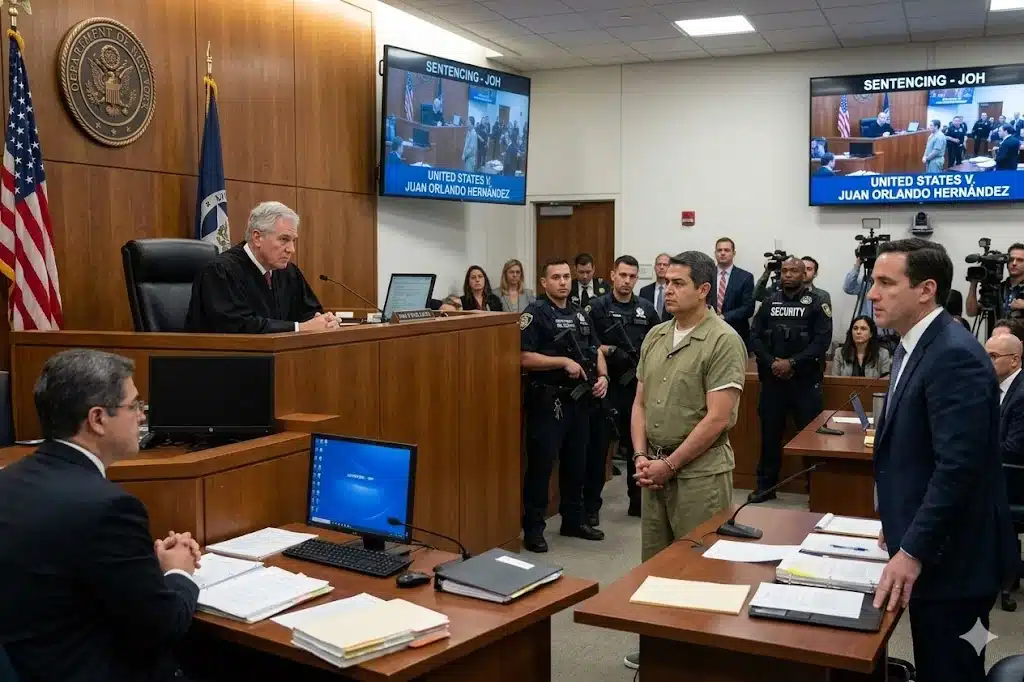
Parlato’s 3rd article in his JOH series was published on Artvoice and Frank Report on May 4, 2026
Overview
Part 3 is the most legally specific installment of Parlato’s series, and in some respects the most interesting. It focuses on a single argument: that the Southern District of New York was the wrong venue for the Hernandez trial, that prosecutors knew it, and that they obtained a false stipulation to keep the case in Manhattan rather than send it to Florida. If the most explosive claim in this piece is true, it represents serious prosecutorial misconduct. But Parlato presents that claim without independent documentation, buries the fact that the judge rejected the venue argument, and wraps a legitimate legal issue inside several layers of speculation and innuendo about judicial bias and jury manipulation.
Claim-by-Claim Fact-Check
✅ ACCURATE: The law on venue for extraterritorial offenses
Parlato correctly cites 18 U.S.C. Section 3238. The statute does say that for offenses committed outside the jurisdiction of any particular state or district, the trial shall be held in the district where the offender “is arrested or is first brought.” If Hernandez entered U.S. custody through Florida upon extradition, as Parlato states, Florida would be the presumptive venue under Section 3238. This is a real law and Parlato reads it correctly. The venue issue is not invented.
This is also not merely a Parlato talking point. The defense’s post-trial motion for a new trial, filed March 22, 2024 in the Southern District of New York, raised exactly this argument in writing: “Mr. Hernandez’s trial was improperly held in the Southern District of New York, even though under 18 U.S.C. Section 3238, it should have been held in the Southern District of Florida, the district to which he was first brought, upon being extradited from Honduras.” That language is in a real court document, not invented by Parlato.
❌ CRITICAL OMISSION: Judge Castel denied the motion
Parlato’s account of the venue dispute ends with the sentencing. He writes that Castel, “presented with a post-trial admission by the prosecution that he had instructed the jury on a false fact regarding a constitutional element of the case, could have ordered briefing, set aside the conviction, or ordered a new trial in the proper district” and instead “sentenced Hernandez to 45 years.”
The implication is that Castel simply ignored the venue problem and plowed ahead with sentencing. That is not what happened. Castel issued a written ruling denying the motion for a new trial. The venue argument was specifically before him, argued on the merits, and rejected. Parlato omits this entirely. A judge denying a motion after argument is not the same as a judge ignoring a problem. Readers of Part 3 are left with no idea that the argument was actually adjudicated.
⚠️ UNVERIFIED: The prosecution “conceded the stipulation was false”
This is the most serious and most unsupported claim in the article. Parlato writes: “The defense’s appeal papers state that the prosecution later conceded the venue stipulation read to the jury was false.”
If accurate, a prosecution concession that it obtained a trial in the wrong venue through a false stipulation would be a significant finding of misconduct. But Parlato provides no link to those appeal papers, quotes no specific language from them, and cites no independent reporting that confirms the prosecution made this concession. The claim rests entirely on Parlato’s paraphrase of documents his readers cannot examine.
The defense’s post-trial motion that is publicly available raises the venue issue and argues the first point of entry was Florida. Whether the prosecution formally “conceded” the stipulation was false, as opposed to simply not contesting the factual point about Florida entry during post-trial proceedings, is a materially different thing. A concession of falsity implies the prosecution knew the stipulation was wrong when it was signed. That is a claim of deliberate misconduct. Parlato presents it as established without establishing it.
❌ MISLEADING: The indictment predating extradition makes the venue argument more complex
Parlato frames the venue issue as if it is straightforward: crimes happened abroad, defendant entered through Florida, trial must be in Florida. But the legal picture is considerably more complicated, and Parlato does not acknowledge the complexity.
The indictment against Hernandez was returned on January 27, 2022, and was filed in the Southern District of New York before he was extradited at all. Under Section 3238, the venue for an extraterritorial offense can also be established in “the district of the last known residence of the offender” when the offender has not yet been “arrested or brought into any district.” The SDNY had an arguable basis to file there before extradition.
Furthermore, academic and appellate treatment of Section 3238 is not as settled as Parlato implies. As the Congressional Research Service has noted, federal appellate courts disagree over whether Section 3238 applies when an offense includes both extraterritorial conduct and some domestic conduct. The cocaine importation conspiracy, which alleged that drugs ultimately entered the United States, arguably had domestic elements. Whether 3238 governed at all, or whether other venue statutes applied, is a genuinely contested legal question that Parlato resolves with one paragraph as if it were obvious.
This does not mean Hernandez’s venue argument was wrong. It may well have been right. But the law is more complicated than “crimes happened abroad, therefore Florida,” and presenting it as a clean, obvious violation understates the actual legal dispute.
❌ SPECULATION: The “forum shopping for a biased judge” argument
Parlato argues that the DOJ chose Manhattan over Miami specifically to get a former-prosecutor judge and avoid a sympathetic jury. He states flatly: “The Biden DOJ knew it would more likely get a pro-prosecution judge in Manhattan.”
This is pure speculation dressed as analysis. Parlato has no evidence of DOJ internal deliberations about judge selection. The claim that SDNY judges are systematically biased toward the prosecution because some were former AUSAs is unsupported. Federal judges, once appointed with lifetime tenure, are not beholden to the office they once worked for. Judge Castel was appointed in 2003 by President George W. Bush, not by any Democratic administration. If there is documented evidence that Castel ruled improperly in ways that prejudiced the defense, that would be worth examining. Parlato offers none.
The implicit argument, that a Florida judge of Cuban or Venezuelan heritage would have been more likely to give Hernandez “a fair trial,” is also worth naming directly. A fair trial means one conducted according to law, not one before a jury demographically likely to be sympathetic to the defendant. Parlato is arguing for favorable jury selection geography under the guise of arguing for procedural fairness, and those are not the same thing.
⚠️ LEGITIMATE BUT INCOMPLETE: The stipulation system concerns
Parlato raises a real issue about how federal stipulations work: they are typically drafted by prosecutors, reviewed by defense counsel, and signed without the defendant necessarily reading them. He is right that this creates a system where a defendant can be bound by a factual agreement he never personally verified.
However, the stipulation system also has a built-in protection: defense counsel is presumed to have reviewed the document before signing. If the stipulation contained a false fact about the point of entry, the question is not just whether the prosecution was dishonest, but why defense counsel signed a document stating Hernandez arrived in New York when the actual extradition flight records would have shown otherwise. Parlato assigns all blame to the prosecution and none to defense counsel’s failure to verify a basic, checkable fact. That framing is convenient but incomplete.
❌ OMISSION: The appeal was dismissed at Hernandez’s own request
Parlato’s series implies that the conviction stands as an unremedied injustice. In April 2026, the U.S. Court of Appeals for the Second Circuit dismissed Hernandez’s appeal and ordered the prior judgment vacated, but only because Hernandez himself asked for the appeal to be eliminated following his pardon. The Second Circuit never ruled on the merits of the venue argument. We do not know how it would have ruled. Parlato presents the conviction as unreviewed when in fact the review process was ended at the defendant’s own request after he received what he wanted: his freedom.
The Core Argument: Real Issue, Unreliable Presentation
The venue problem Parlato identifies in Part 3 is, on the available record, the most legally substantive argument in the series. The defense did raise it in court. The statute does say what Parlato says it says. If the prosecution obtained a false stipulation placing the defendant in New York when the records showed Florida, that is a real problem worth scrutinizing.
But Parlato’s presentation undercuts the argument’s credibility in three ways. First, the prosecution concession claim is unverified and unsourced beyond Parlato’s own paraphrase. Second, Parlato never tells readers that Judge Castel heard this argument and denied it. Third, the legitimate legal concern is surrounded by unsupported claims about judicial bias and jury manipulation that read as conspiracy theorizing rather than legal analysis.
A serious treatment of a real venue problem deserves better than this. Instead of making the strongest possible documented case, Parlato buries the legal argument under speculation, omits the adverse ruling, and invites readers to conclude the fix was in without providing the evidence that would actually demonstrate it.
Summary Scorecard
| Claim | Verdict |
|---|---|
| 18 U.S.C. Section 3238 governs venue for extraterritorial offenses | ✅ Accurate |
| Defense raised the Florida venue argument in post-trial filings | ✅ Accurate and verified in court documents |
| Prosecution conceded the stipulation was false | ⚠️ Unverified, sourced only from Parlato’s paraphrase of unseen documents |
| Castel ignored the venue problem and just sentenced Hernandez | ❌ False: Castel denied the motion for new trial in a written ruling |
| The venue law is clear and obviously required Florida | ❌ Oversimplified: circuit courts disagree on how Section 3238 applies to mixed domestic-extraterritorial conspiracies |
| The DOJ chose Manhattan to get a biased judge | ❌ Speculation with no documented basis |
| A South Florida jury would have given a fairer trial | ❌ Substitutes demographic sympathy for procedural fairness |
| The conviction stands unreviewed on appeal | ❌ Misleading: appeal was dismissed at Hernandez’s own request after the pardon |
This article is part of the Snow Job series: a complete fact-check of Frank Parlato’s six-part defense of convicted drug trafficker Juan Orlando Hernandez.
- Snow Job: Fact-Checking Frank Parlato’s White Wash of Honduran President Juan Orlando Hernandez
- Snow Job, Part 2: Fact-Checking Parlato’s Case-Within-a-Case on Juan Orlando Hernandez
- Snow Job, Part 3: Fact-Checking Parlato’s Venue Argument Against the Hernandez Prosecution
- Snow Job Part 4: Fact-Checking Parlato’s “Prosecutors Coached the Lie”
- Snow Job Part 5: Fact-Checking Parlato’s “No Corroboration” Argument on Hernandez
- Snow Job Part 6: Fact-Checking Parlato’s Finale on Juan Orlando Hernandez
- Snow Job, Part 7: Fact-Checking Parlato’s “Venue Lie” Argument on Hernandez